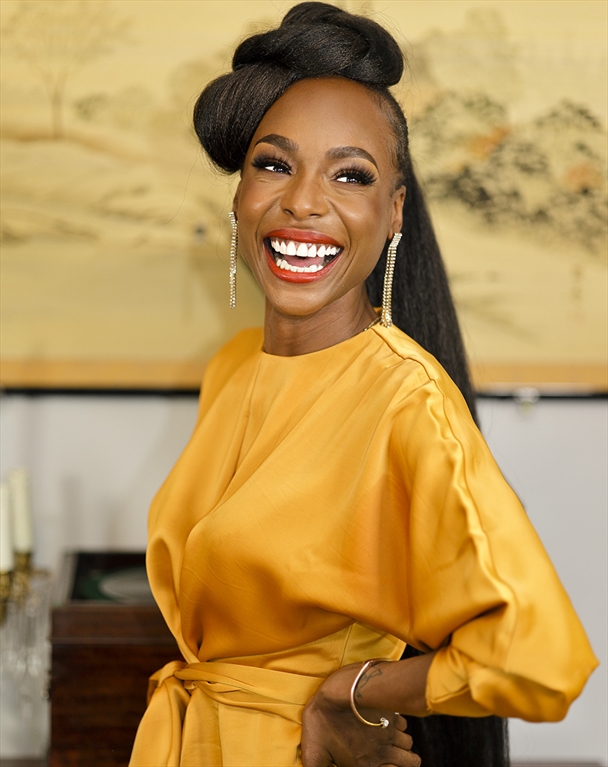
Posted on Thursday, June 22, 2023Tara M. Stringfellow
The author of the bestselling novel Memphis, Northwestern University alumna Tara M. Stringfellow ’07, ’18 MFA is also a poet, former attorney, and semifinalist for the Fulbright Fellowship. Her work has appeared in numerous publications, such as Collective Unrest, Minerva Rising, Jet Fuel Review, WomenArts Quarterly Journal, and Apogee. After living all over the world, including in Japan, Ghana, Spain, and Italy, Stringfellow moved back to Memphis, Tennessee, where her family roots run deep. This was what inspired her to write Memphis, “a spellbinding debut tracing three generations of a Southern Black family and one daughter’s discovery that she has the power to change their legacy.” She discusses her time at Northwestern, writing her debut novel, and what’s next for her.
What drew you to Northwestern for your undergraduate experience?
Honestly, y’all wouldn’t leave me alone. I was getting letters and phone calls daily a month away from decision time in the spring. And truly, I was dodging y’all because my parents simply couldn’t afford it. When an admissions officer heard my reasoning, she called later that afternoon with a significantly lower parent contribution. I said yes on the phone through tears. Unlike all the other universities, Northwestern treated me like a person.
About 10 years after graduating in 2007, you decided to return to obtain your MFA. What inspired your decision?
I was an attorney, married with a dog, living in a penthouse apartment in the Gold Coast, and I was utterly, completely bored. If that was the American dream, I didn’t want it. I decided, at 30 years old, to pursue my first love—writing. I applied to Northwestern’s MFA program, but I didn’t tell a soul. And when I got in, I informed my husband that I would be leaving him to pursue what I had always wanted to be: a writer.
How did your time at the University prepare you to write Memphis?
Northwestern is no joke. My professors trained me diligently, to not only write creatively, but to also take a technical, editorial hand to my writing. A major part of writing is editing your work to make it better, more meaningful, more impactful. Northwestern professors are pioneers in that regard. They force you to cut, to throw away entirely, to start over, to reassess, to attack the meat of the story from an entirely different point of view. And that process makes for great storytelling.
What is something that surprised you—or might surprise other people—about the process of writing a novel?
The business side of things surprised me. I didn’t realize that publishing houses had risk analysis models built in to calculate your book’s projected sales, that certain books are lead titles and thus have more marketing and publicity resources available. Yes, we’re in the business of creating lasting works of art, but it is a business.
Do you have any advice for aspiring writers?
Give it your all. I’ve met many folks who say they want to be writers but don’t actually carve out the time to sit down and write. Do that. Write every day. Write with all that is in you.
What are you currently working on that you’re excited about? Is there another book in the works?
I’m editing my next book, a collection of poetry to be published in 2024 with The Dial Press and Penguin Random House. And I’m in the midst of writing my second novel.
Explore other books on the NU Loyal 2023 Summer Reading List, featuring selected works by some of Northwestern’s esteemed alumni and faculty.